Ha Giang Motorbike Loop: Complete Guide to Vietnam's Most Epic Ride
There are roads that test a rider. Then there is the Ha Giang loop — a circuit through Vietnam's northernmost province that doesn't just test you, it transforms you. At over 1,000 meters above sea level, the Dong Van Karst Plateau stretches across a UNESCO Global Geopark of ancient limestone formations, some dating back hundreds of millions of years. The road that winds through it — National Highway 4C — drops into gorges 800 meters deep, scales passes with nine hairpin turns, and arrives at flagpoles perched on the literal edge of Vietnam.
For riders who have done the Hai Van Pass or the Ho Chi Minh Highway, Ha Giang is the logical next chapter. But it demands more preparation, more patience, and a fundamentally different mindset. The distances between fuel stops stretch long. Mobile signal disappears for hours. And the landscape, particularly in the section between Dong Van and Meo Vac, is so overwhelming that stopping every ten minutes to stare becomes inevitable.
This guide covers 20 specific destinations along the Ha Giang motorbike loop, drawn from the actual route, with practical details on entrance fees, elevation, and what makes each stop genuinely worth your time.
Why the Ha Giang Loop Earns Its Reputation Among Serious Riders
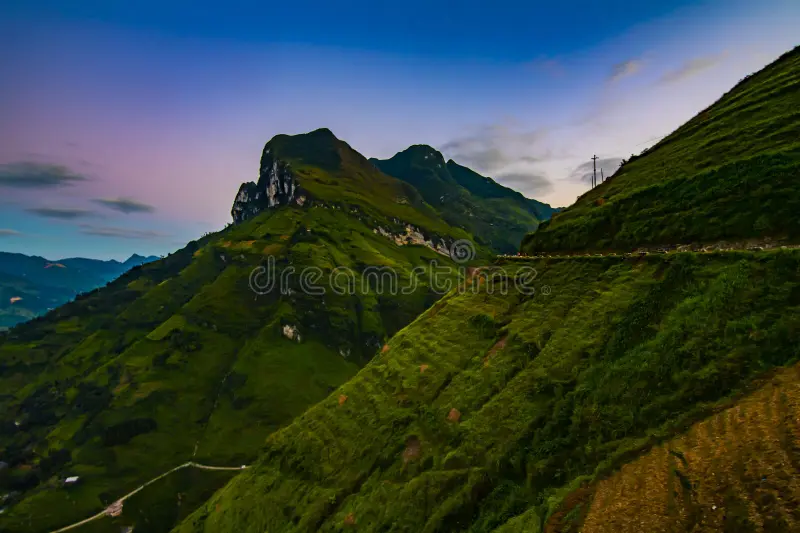
The standard Ha Giang loop runs roughly 350 kilometers in a circuit from Ha Giang city, north through Quan Ba and Yen Minh, then east through Dong Van and Meo Vac, before looping back south. Most riders complete it in three to four days, though those who stop properly at every destination often stretch it to five or six.
What separates Ha Giang from other Vietnamese mountain routes is the combination of technical riding and cultural density. Within a single day's ride, a traveler can move through Kinh lowland towns, Hmong villages perched on cliff faces, Dao communities working traditional looms, and ancient stone settlements that predate French colonialism by centuries. The Ha Giang province culture and history is layered into the geography itself — you cannot separate the landscape from the people who have shaped it.
Road conditions vary significantly by season. The October to April window offers the clearest skies and the famous buckwheat flower blooms from October through November, when the valleys around Sung La fill with pale pink and white. From May through September, heavy rains increase the risk of rockslides and make certain passes genuinely dangerous. Experienced riders consistently recommend the October to early December period as the sweet spot for photography and road safety combined.
The Northern Circuit: From Ha Giang City to Quan Ba and Yen Minh
The loop begins in Ha Giang city proper, where the Km 0 marker serves as the obligatory first photograph. From there, Highway 4C climbs steadily northward toward Quan Ba district, gaining altitude quickly enough that riders typically feel the temperature drop within 45 minutes of leaving the city.
Quan Ba Heaven Gate (Cổng Trời Quản Bạ) sits on the boundary between Quan Ba and Vi Xuyen districts at a natural mountain pass. Entry is free, and the viewpoint here frames the Twin Mountains — two near-perfect conical peaks rising from the valley floor — in a way that most visitors describe as the first genuinely jaw-dropping moment of the trip. On clear mornings before 9 AM, the mist settles between the peaks and the valley, creating the kind of composition that explains why Ha Giang photography has developed its own following.
From Quan Ba, the route continues east toward Yen Minh, passing through the Sung La Valley (Thung Lũng Sủng Là). This valley gained wider recognition after the 2005 Vietnamese film Chuyện của Pao, which was shot on location here. The buckwheat fields that blanket the valley floor in autumn turn it into one of the most photographed landscapes in northern Vietnam. Entry is free, and the valley floor can be explored on foot or by motorbike along a network of dirt tracks through the H'Mong settlements.
Lung Kuy Cave (Động Lùng Khúy) near Yen Minh warrants a deliberate stop. At approximately 1,000 meters long, it is considered the largest cave on the Dong Van plateau, with the local tourism board designating it the "first cave of the northwest plateau." Entrance costs 50,000 VND. The cave's interior maintains a stable cool temperature, which makes it a legitimate rest stop in summer months, not just a tourist tick.
Dong Van: The Ancient Heart of the Stone Plateau
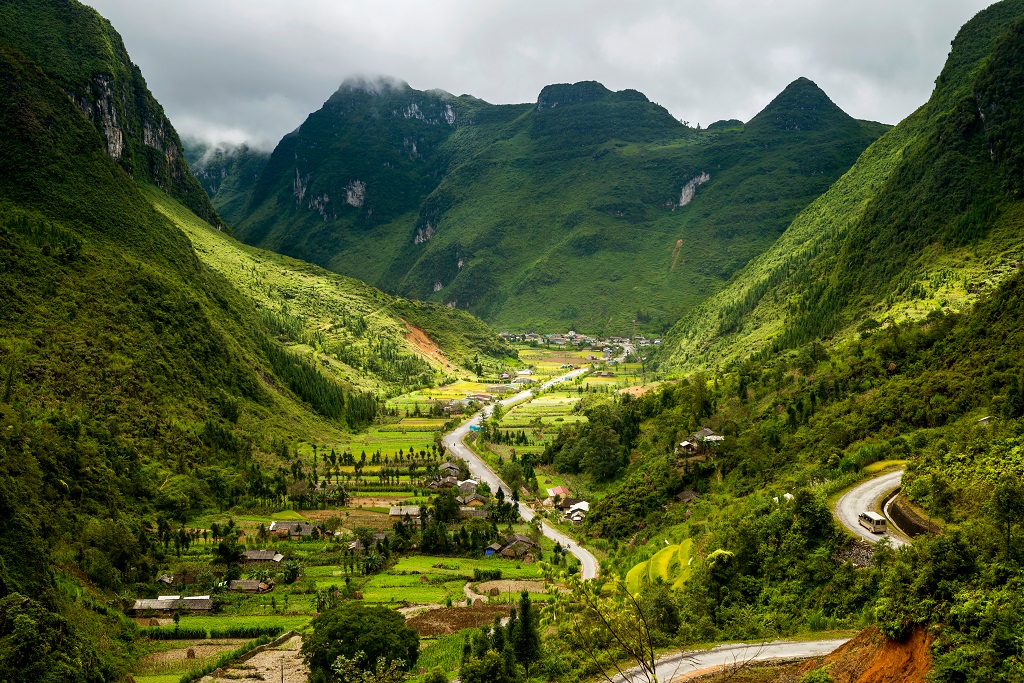
Dong Van Old Town (Phố Cổ Đồng Văn) stands approximately 150 kilometers north of Ha Giang city, and the ride alone justifies the distance. The old quarter contains French colonial-era shophouses alongside traditional H'Mong stone architecture, most of them a century or more old. Entrance to the heritage zone costs adults 50,000 VND and children 20,000 VND. The town functions as both a living community and a preserved historical district — families still operate their homes and businesses within the protected buildings.
The Dong Van Karst Plateau Geopark (Cao Nguyên Đá Đồng Văn) surrounding the town received UNESCO Global Geopark designation, recognizing its limestone formations that reach elevations over 1,000 meters. The plateau covers four districts — Quan Ba, Yen Minh, Dong Van, and Meo Vac — and the motorbike loop threads through all of them. Entry to the plateau itself is free; the designation simply means that certain geological formations are protected from quarrying and development.
Lung Cu Flag Tower (Cột Cờ Lũng Cú) marks Vietnam's northernmost point, sitting at the border with China. The 30-meter flagpole is visible from considerable distance, and climbing to the base of the tower costs 25,000 VND. An electric vehicle from the parking area up the hill costs an additional 15,000 VND, though most riders walk the final stretch. The view from the tower encompasses both the Vietnamese side — with its rice terraces, stone walls, and village rooftops — and the Chinese border in the near distance.
Vua Meo Palace (Dinh Vua Mèo), the former residence of the H'Mong king Vuong Chi Sinh, sits in Xa Phin commune near Dong Van. The compound was built in 1919 on a hill shaped like a turtle according to local accounts, and the architecture blends H'Mong, Chinese, and French influences in a way that is genuinely unusual for the region. Entrance costs 25,000 VND. The palace now functions as a museum, with period furniture, photographs, and explanations of the Vuong family's role in the region's 20th-century history.
Pao's House (Nhà Của Pao), located near Sung La, recreates a traditional H'Mong family home from the 1947 period and was the primary filming location for Chuyện của Pao. Entrance costs 10,000 VND, with an optional traditional costume rental for the same price. For travelers interested in H'Mong architectural traditions — the thick stone walls, low doorways, and central hearth arrangement — this is one of the more accessible and well-preserved examples on the route.
Ma Pi Leng and the Nho Que River: The Most Dramatic Section
Between Dong Van and Meo Vac lies the 20-kilometer Ma Pi Leng Pass (Đèo Mã Pì Lèng), consistently described by experienced riders as one of the most technically demanding and visually spectacular mountain roads in Southeast Asia. The pass reaches approximately 1,200 meters elevation and was reportedly carved by hand over several years during the 1960s, with workers suspended from ropes to access the cliff faces. Entry to the pass itself is free.
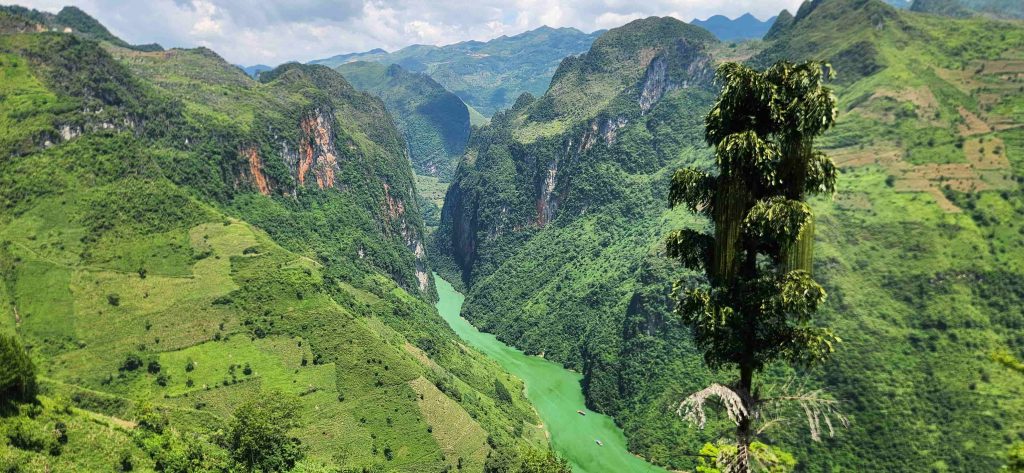
The descent from Ma Pi Leng into Meo Vac district brings riders to the Nho Que River (Sông Nho Quế), a 200-kilometer waterway whose turquoise color — produced by minerals dissolved from the surrounding limestone — creates a visual contrast with the grey cliff walls that most photographs struggle to fully capture. The Tu San Canyon cut by the river reaches 800 meters from cliff rim to water level, making it one of the deepest river gorges in Southeast Asia. Boat tours on the river cost between 100,000 and 120,000 VND and typically run 30 to 45 minutes.
The Tham Ma Descent (Con Dốc Thẩm Mã) on the approach to Dong Van from the east features nine consecutive switchback curves descending a steep hillside. For riders coming from Meo Vac, this section requires careful speed management and full attention. The drop rewards patience — at the bottom, the road levels into a valley where H'Mong families tend small plots between the limestone outcrops.
Cultural Stops That Most Riders Underestimate
Khau Vai Love Market (Chợ Tình Khâu Vai) takes place annually on the 27th day of the third lunar month in Meo Vac district. The market has a documented history of serving as a gathering point for separated couples and former lovers from different ethnic communities — a tradition that predates modern Vietnamese administrative boundaries. The market is free to attend and remains an active community event rather than a staged performance.
Lung Tam Brocade Weaving Village (Làng Dệt Thổ Cẩm Lùng Tám) sits approximately 50 kilometers from Ha Giang city and represents one of the more accessible entry points into traditional Dao textile culture. The village is free to visit, and the weavers operate open workshops where the process of natural dyeing and hand-loom weaving can be observed directly. Purchasing directly from the weavers supports the community and provides textiles with documented provenance.
Bac Me Prison (Căng Bắc Mê) is a historical site that served as a colonial-era detention facility and later a revolutionary prison during the resistance period. Entry costs 10,000 VND. For travelers interested in Vietnam's 20th-century history, particularly the period of anti-French resistance in the northern highlands, this site provides context that purely natural or cultural attractions do not.
The Nam An Ecotourism Area (Khu Du Lịch Sinh Thái Nặm An) focuses on Dao ethnic community experiences and traditional festival programming. Entrance costs 50,000 VND. The community-run format means that revenue stays within the village, and the traditional festival demonstrations are scheduled rather than spontaneous — worth checking timing before building the itinerary around this stop.
Planning the Loop: Practical Considerations for Motorbike Riders
Most riders hire semi-automatic 110cc to 150cc motorbikes in Ha Giang city for approximately 150,000 to 200,000 VND per day. Manual transmission bikes are available for experienced riders who want more control on steep descents. Renting a motorbike in Ha Giang requires a valid license — technically, a Vietnamese or internationally-recognized motorbike license for bikes above 50cc — though enforcement varies.
Fuel stations become sparse north of Yen Minh toward Dong Van. Experienced riders carry a small backup fuel container, typically one to two liters, to bridge the longer gaps. The section from Meo Vac back to Ha Giang city passes through more populated areas with more regular fuel access.
Accommodation exists at each major district town — Ha Giang city, Quan Ba, Yen Minh, Dong Van, and Meo Vac — in a range from basic guesthouses at 100,000 to 150,000 VND per night to newer boutique homestays in the 300,000 to 500,000 VND range. Dong Van Old Town itself has a concentration of guesthouses within the heritage zone, which places riders close to the early-morning light before other travelers arrive.
The Thien Thuy Cave (Hang Thiên Thủy) near Yen Minh district measures approximately 340 meters in length and features stalactite formations throughout. Entry is free. It functions as a secondary cave option for those who want to compare formations with Lung Kuy Cave earlier on the route.
Pho Bang Ancient Town (Thị Trấn Phó Bảng) sits within the stone plateau valley and represents a different architectural layer than Dong Van — smaller, quieter, and with fewer visitors. Entry is free. The town's stone walls and traditional shophouses date to a period when it served as a trading hub between highland communities and lowland merchants.
Pa Vi Ha Village (Thôn Pả Vi Hạ), a Hmong community settlement below the Ma Pi Leng pass, offers a ground-level perspective on the communities that have lived alongside this dramatic geography for generations. Entry is free. The walk through the village from the roadside parking area takes approximately 20 minutes and passes working fields, animal enclosures, and the stone-walled homes characteristic of highland H'Mong construction.
What the Ha Giang Loop Actually Demands
The three most important things the Ha Giang loop requires are: time, physical readiness for long saddle hours, and genuine respect for the road conditions. Riders who rush the circuit in two days see the geography but miss the culture. The markets in Dong Van old town open early and close mid-morning. The light on the Nho Que River is best between 9 and 11 AM. The evening views from Lung Cu require arriving before sunset, which means planning the prior day's distance accordingly.
Physical fatigue is real on this route. The combination of altitude, technical riding, and cold temperatures in the upper districts — particularly from October through February, when evening temperatures in Dong Van can drop to near-freezing — creates demands that a flat-road rider will not anticipate. Layered clothing, rain gear, and proper riding gloves are not optional considerations.
The Ha Giang loop is one of those routes where the standard travel advice — go slowly, stop often, talk to people — is not a cliché but an operational requirement. Every destination on this list repays attention. The entrance fees are uniformly modest; the real cost is the willingness to stop, get off the bike, and let the place arrive at its own pace.
Câu hỏi thường gặp
Do I need an International Driving Permit (IDP) to ride a motorbike in Ha Giang?
Technically, Vietnamese law requires a valid motorbike license for bikes above 50cc, and an IDP is recognized alongside a home-country license for foreign visitors. In practice, enforcement checkpoints exist at the entrance to Ha Giang province and occasionally at district boundaries. Many riders report no issues with a home-country license, but carrying an IDP significantly reduces the risk of fines or delays. Renting from reputable shops in Ha Giang city also means the rental agreement itself provides some documentation if stopped.
What is the best time of year to ride the Ha Giang loop?
October and November offer the most favorable combination of clear weather, buckwheat flower blooms in Sung La Valley, and manageable road conditions. March and April also see good weather and the yellow mustard flower season in the plateau. The rainy season from May through September brings a higher risk of landslides and slippery passes, particularly on the Ma Pi Leng section. December through February is cold — especially above 1,000 meters — but offers clear skies and very thin crowds at most sites.
Can I hire a local guide (xe ôm driver) instead of riding myself?
Yes, and for first-time visitors to the region this is worth serious consideration. Local xe ôm drivers — many of whom are H'Mong or Dao community members — know the road conditions, speak some Vietnamese and often basic English, and can facilitate introductions at villages and markets that a solo foreign rider would navigate with more difficulty. Prices for a guided loop typically range from 500,000 to 800,000 VND per day for driver plus bike. Some travelers ride their own bike while the guide rides alongside as a navigator.
How far in advance should accommodation be booked, especially in Dong Van?
During the peak season of October to November, guesthouses in Dong Van Old Town fill quickly, particularly the smaller heritage-style properties within the protected quarter. Booking two to three weeks ahead is advisable for this period. During the off-season from January through July, walk-in availability is generally reliable. Meo Vac and Yen Minh have less accommodation pressure than Dong Van but more limited selection overall.
Is the Ha Giang loop suitable for riders with limited mountain road experience?
The loop is manageable for intermediate riders who have prior experience with steep, winding roads — but it is not appropriate for beginners. The Ma Pi Leng section in particular requires confident brake management on steep descents and the ability to hold a line through continuous switchbacks. The Tham Ma descent with its nine-curve series demands the same. Riders who have not previously navigated mountain passes at elevation should consider spending a day on the lowland sections around Ha Giang city first to assess their comfort level before committing to the full northern circuit.